I picked up the workflow from an earlier post here (spot a winner in one category, adapt the pattern to your own production capability) and pointed it at a very specific question this week: which 2D printed t-shirt winners can be reproduced as embroidered shirts without losing any of what makes them work?
The short answer is that a surprising number of them can, and the ones that can are the exact same designs that already dominate their 2D print niches. Embroidery is one of the greenest apparel niches on Etsy right now because production cost keeps most sellers out, and the buyers who filter for it are willing to pay 40 to 60% more per unit. If you can pick 2D winners that translate cleanly to thread, you get to enter a much less crowded market with designs already validated by a much more crowded one.
Below is what I look for.
The core observation
Embroidery has strict technical constraints. Thread has minimum thickness. Detail below a certain size becomes a knotted mess. Colors are limited to what your machine can load without a re-thread. Photographic gradient does not exist in embroidery.
That sounds like a limitation, but flip it around: any design that already works on 2D print while respecting those same constraints is essentially free inventory for an embroidery shop.
The 2D sellers do the discovery work. You take their proven pattern and re-produce it in a medium that gates competitors out.
Example 1: The "life is good" simple graphic tee
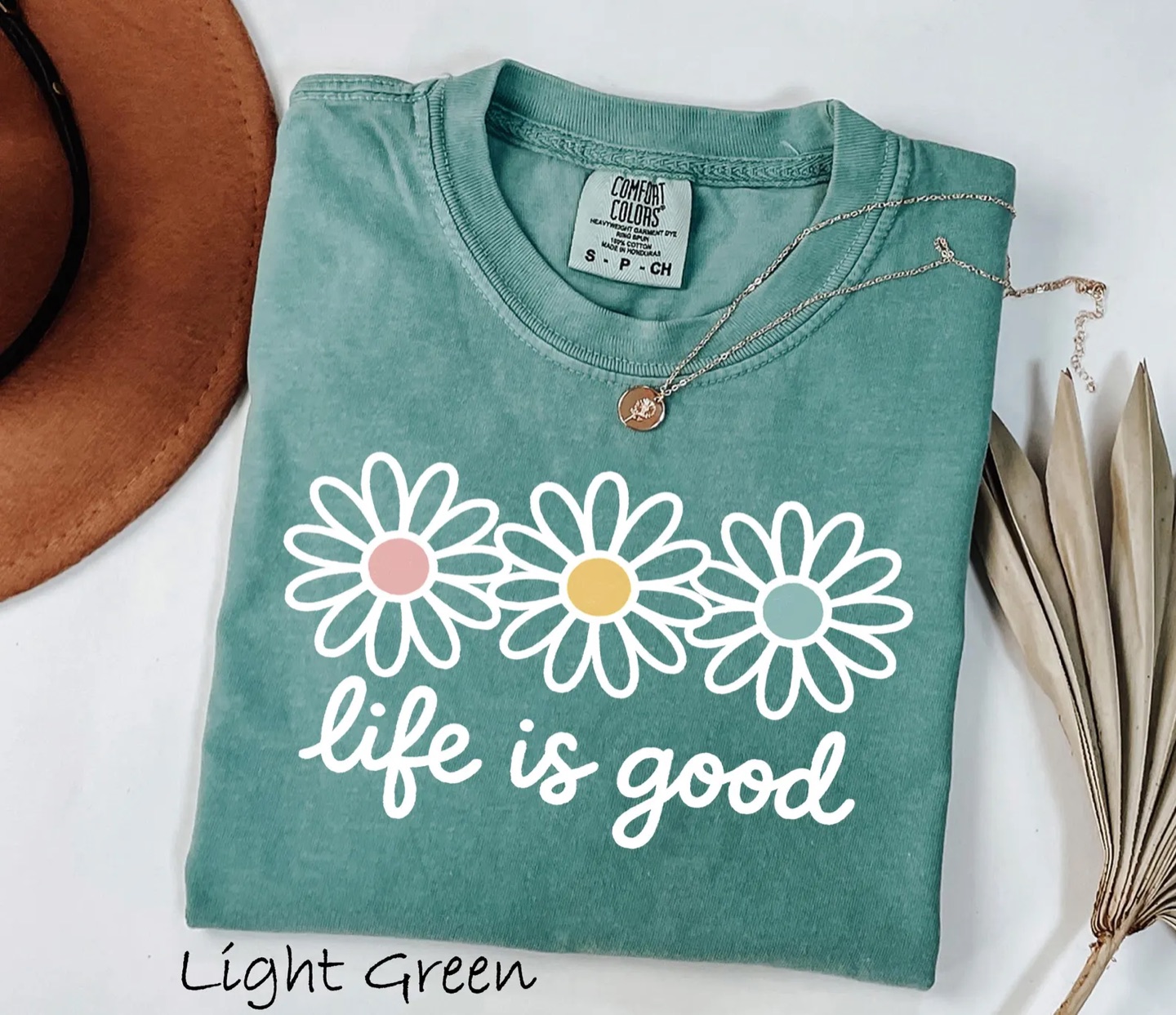
This one is a textbook case. A Comfort Colors light green tee with three daisies outlined in white and the phrase "life is good" in cursive underneath. Three tiny color dots in the center of each daisy for accent.
The metrics on this listing are what caught my eye:
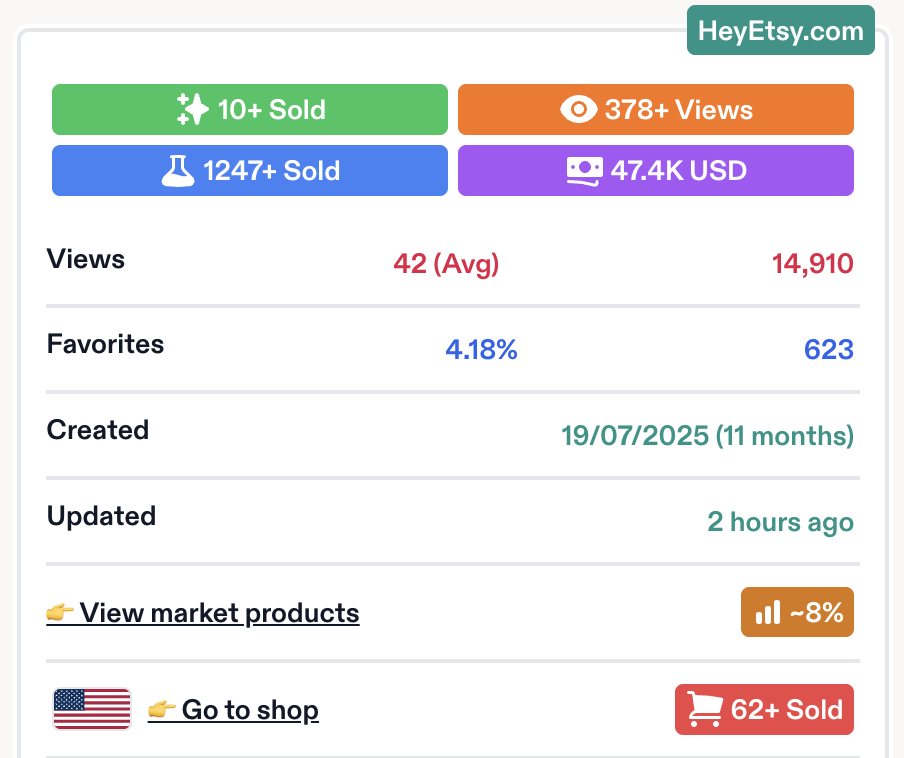
- 1247+ total sales, roughly $47,400 in revenue on this one design
- 42 average views per day, 14,910 total, so the listing pulls consistently across the whole 11 months since it launched
- 4.18% favorites-to-views ratio, well above the "just browsing" threshold
- Created 11 months ago, meaning it has already lived through one full seasonal cycle without dropping off
Now look at the design itself with an embroidery lens. Every element is embroidery-friendly:
- Bold cursive script of appropriate weight. No hairline strokes anywhere.
- Three separate simple shapes (the flowers) with clear outlines and open interiors.
- A tiny accent color per flower (three flat color dots). That is one extra thread color, not fifteen.
- No gradient, no photorealism, no fine detail.
The whole design is essentially three flat shapes plus one line of script text. That is exactly the vocabulary of embroidery. A shop with a mid-tier embroidery machine can reproduce this design at production quality on the first pass.
Example 2: Pet portrait crewnecks, already proving the model
Pet portrait embroidered crewnecks are worth studying because they are the same idea already at scale. The whole niche is essentially a small group of shops who spotted "customized pet name shirt" winning as 2D print and moved it to embroidery.
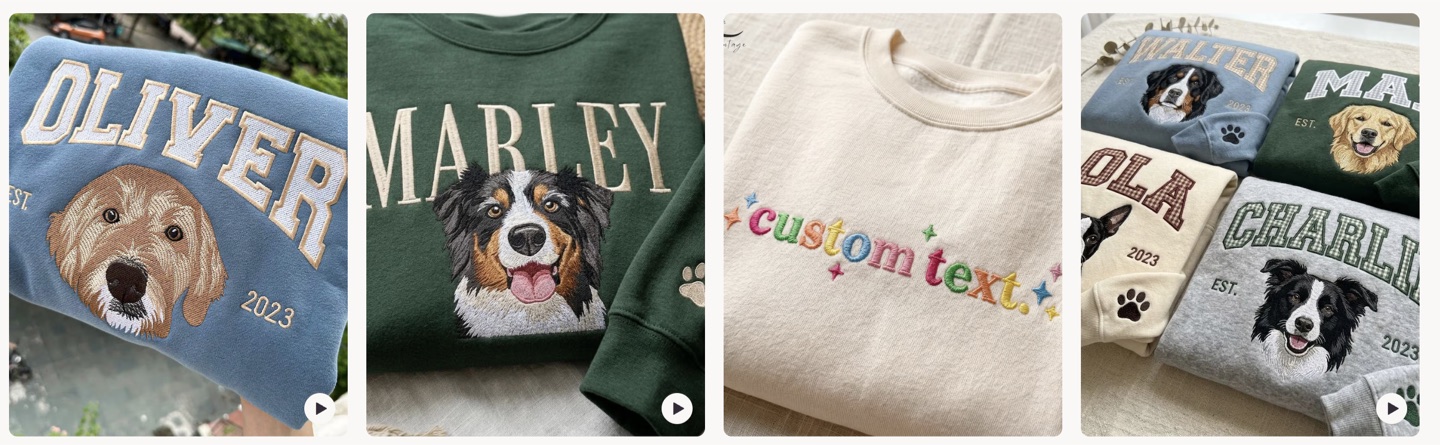
Look at what they carry over from the 2D winner and what they add:
Carried over from 2D: the modular composition (name arched at top, portrait or subject below, year at bottom), the varsity-style typography, and the classic Comfort Colors crewneck as the base.
Added by moving to embroidery: the price bump ($55 to $75 versus $32 to $38 for a 2D print), the wait-time expectation (buyers accept 5 to 10 days), and the tactile signal that says "premium gift" the moment the recipient touches it.
The pattern says: even without changing the design language, the medium switch alone is worth 60 to 100% more per sale.
Example 3: The bible verse script tee
The third example is the "Be still & know" Psalm 46:10 tee on brown Comfort Colors. This one caught my eye because it is a script-heavy design (not just a graphic), and script text is where embroidery either shines or collapses.
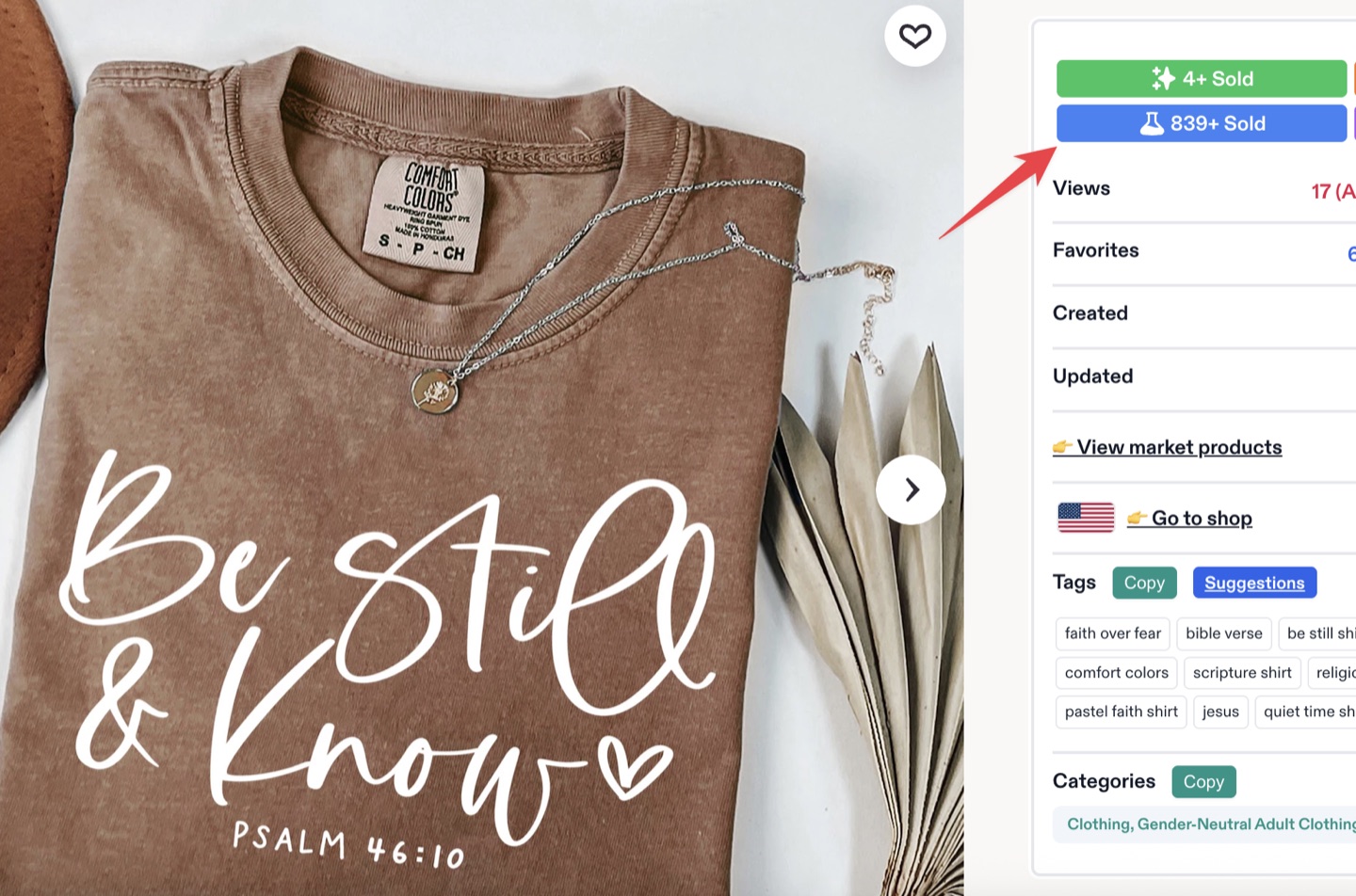
- 839+ total sales on this one listing
- A tag cloud full of community language:
faith over fear,bible verse,be still shirt,comfort colors,scripture shirt,religious,pastel faith shirt,jesus,quiet time shirt - Design elements: one big cursive script phrase, one tiny outline heart, one small line of block text for the verse citation
Every element on this listing embroiders cleanly. The cursive is large and thick enough for satin stitch. The heart is a single closed shape. The verse citation is a small line of block text at the bottom, which is the easiest thing an embroidery machine does.
An embroidered version of this design in the same brown Comfort Colors would slot straight into the same buyer intent. The tag cloud already shows Comfort Colors as a search term. Adding "embroidered" to the tag mix opens a second search channel with almost no competitor at the top of it.
The checklist for "embroidery-friendly" 2D winners
Watching those three winners side by side, here is what I now look for when scanning 2D print bestsellers for embroidery-adaptable candidates:
- Text weight and size. Look for script or bold sans-serif at a size that would be embroiderable at 3 to 5 cm tall. Hairline strokes, tiny cursive, or 8 pt paragraphs are hard-no.
- Two to five flat colors. Every color is a thread change on the machine. Winners with 12 colors and gradients are physically not reproducible without doubling production time.
- Simple closed shapes for graphics. Outlined flowers, silhouettes, block letters, small hearts, single lines. Anything photographic is a hard-no.
- No small detail below 3 mm equivalent. Embroidery does not resolve detail below the machine's minimum stitch length. If you can see fine fabric detail in the 2D winner, it will not survive on thread.
- A base product that wears both 2D and embroidery. Comfort Colors 1717 does. So does Bella+Canvas 3001. Very thin fashion tees do not.
Apply the checklist to a listing you found in step 2 of the wider workflow. If it passes all five, the design is a candidate. If it fails on one, you can sometimes fix it (thicken the font, drop a color, simplify a shape). If it fails on three, move on.
Why embroidery is still a green niche in 2026
Three structural reasons:
- Production cost keeps most sellers out. An embroidery machine is not a $200 heat press. Barrier to entry is higher, so the seller count is lower per niche.
- Production time is longer, and Etsy shoppers accept that for gifts. The gift buyer will happily wait 7 to 10 days for something that feels premium. That expectation is a moat.
- The 40 to 60% price premium is real. Buyers pay it because the tactile signal ("this took actual effort to make") lands the moment they open the package. That premium is the compensation for taking on the higher production cost.
Add those three together and embroidery is a niche where a small shop with the right base product and a validated design pattern can compete at a much higher price point with much lower marketing pressure than 2D print.
Common mistakes
- Adapting a design that has fine detail. Fine detail on 2D print reads as "well-made". The same detail on embroidery reads as "someone tried to do too much" and lowers perceived quality. Simpler is better on thread.
- Skipping the base product check. Comfort Colors is the safe answer for both mediums. If the 2D winner runs on a specialty base (streetwear tee, athletic fit), test the embroidery adaptation on a matching base before committing to inventory.
- Missing the community-language tags. The 2D winner's tag cloud is a gift. Copy the specific niche phrases (
quiet time shirt,dog mom crewneck,custom pet portrait) into your embroidered listing, not just generic "embroidered shirt" tags. Community tags pull the buyer intent that generic tags miss. - Overpricing on day one. A brand-new embroidered listing without reviews should list at the low end of the premium band ($48 to $55), not the top ($75). Reviews earn the top of the band. Start where new buyers will risk trying you.
Why this workflow is worth 20 minutes a week
Watching 2D print bestsellers for embroidery-adaptable candidates is a 20-minute weekly ritual. Do it consistently for three months and you will accumulate a shortlist of ten to fifteen validated design patterns you can enter with almost no design-risk. Compare that to three months of designing from scratch and hoping.
If manually scanning 2D print winners against an embroidery checklist sounds tedious, that is exactly the surfacing job HeySeller is being built for: winners sorted by category, with a "medium transfer" score against embroidery, print-on-demand, and other production paths. Join the beta →