Most sellers waste weeks brainstorming what to sell next. The faster move is boring: find listings already selling well, understand exactly why, and remix them for a niche you can compete in.
This isn't copying. It's what every product designer does. Spot patterns in what buyers love, then apply those patterns to your own product line. Done right, it's the highest-leverage research work a small Etsy shop can do.
Here's the workflow, with a real example at the end.
The core rule: demand shows up in data, not guesswork
Every Etsy listing leaks signals about how it's performing. If you know where to look, the platform tells you almost everything:
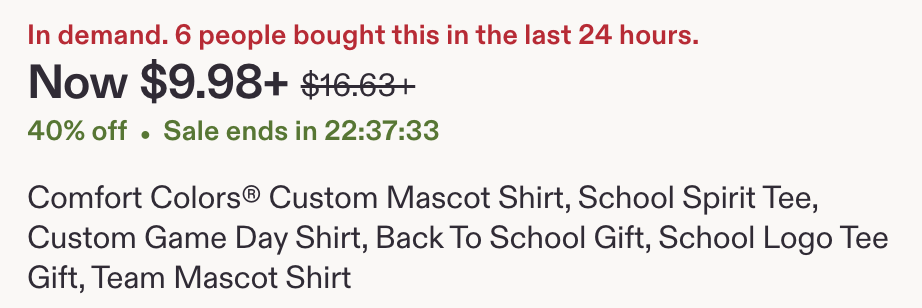
- "In demand" badges. Etsy adds the red "6 people bought this in the last 24 hours" strip when velocity crosses an internal threshold. It's a live signal from Etsy's own algorithm.
- View count and views/day: how many shoppers actually looked at the listing recently, and the trend.
- Favorites: the strongest buyer interest signal short of an actual purchase. A high favorites-to-views ratio (>5%) means the listing is genuinely resonating.
- Days since the listing was created: is this a proven long-term winner or a fresh, un-tested spike?
- Sales-to-views conversion rate: the ultimate health check. Views without sales is a search-visibility problem; sales-per-view above 3–5% is a strong product.
Guessing what will sell means competing against every other seller who's also guessing. Reading the data means competing against the far smaller group of sellers who actually take the time to look.
The 4-step method
Step 1: Cast a wider net than your own niche
Don't search only "embroidered dad shirt" if that's your product. Search the broader category first. "personalized shirt", "custom apparel", "gift shirt for dad". You want to see hundreds of listings so patterns emerge across shops, not just one shop's tricks.
Rule of thumb: research 3–5 categories adjacent to yours. Not exact competitors (they've already saturated your niche), not random ones (patterns won't transfer). Adjacent means: same buyer intent (gift for dad), different medium (embroidered vs 2D print), or same occasion (birthday) different product (mug vs shirt).
That's where transferable design patterns live.
Step 2: Filter to real winners, not vanity metrics
A listing with 5,000 views but 10 sales isn't a winner. It's a listing that showed up in a lot of searches but didn't convert. You'll waste time studying the wrong signal.
Real winners meet at least one of these:
- ≥100 sales in the last 30 days (sustainable velocity)
- ≥5% favorites-to-views ratio (buyer interest is high)
- Etsy's own "In demand" tag (Etsy's algorithm agrees)
- Bestseller badge on a listing under 8 weeks old (fresh momentum, not old reviews carrying it)
Sort search results by "Bestseller" first, then cross-reference the listing age. A 4-week-old listing already sitting at Bestseller status is a much stronger signal than a 2-year-old listing coasting on 800 old reviews. Fresh winners tell you what's rising right now.
Step 3: Extract the transferable pattern. This is the step most sellers skip
When you find a winner, the winner is almost never the whole listing. It's usually one specific element doing 80% of the selling work. Your job is to figure out which element.
Ask yourself, honestly:
- Is it the hook keyword in the title? ("first Father's Day", "custom pet portrait", "birth flower")
- Is it the composition of the hero image? (centered subject, minimal background, bold text placement)
- Is it the personalization variable? (name, date, initials, coordinates. Anything that turns a generic gift into "for someone specific")
- Is it the niche skin? (aesthetic palette. Coquette pink-and-bows, western tan-and-suede, dark academia moody browns)
- Is it the occasion timing? (a Mother's Day gift listed in early April catches all the search build-up)
Write down your best guess. Then verify it: look at 5–10 other winners in the same broad category and check whether that same element appears. If yes, you've found a durable pattern. If no, the original winner is probably riding on brand recognition, paid ads, or a viral moment. And cloning it won't work for you.
Step 4: Swap the medium, keep the pattern
This is the "adapt" part. You keep the transferable element that's doing the work, and swap everything else to fit your production capability and your niche.
A worked example makes this concrete.
Worked example: from 2D print to embroidered shirt
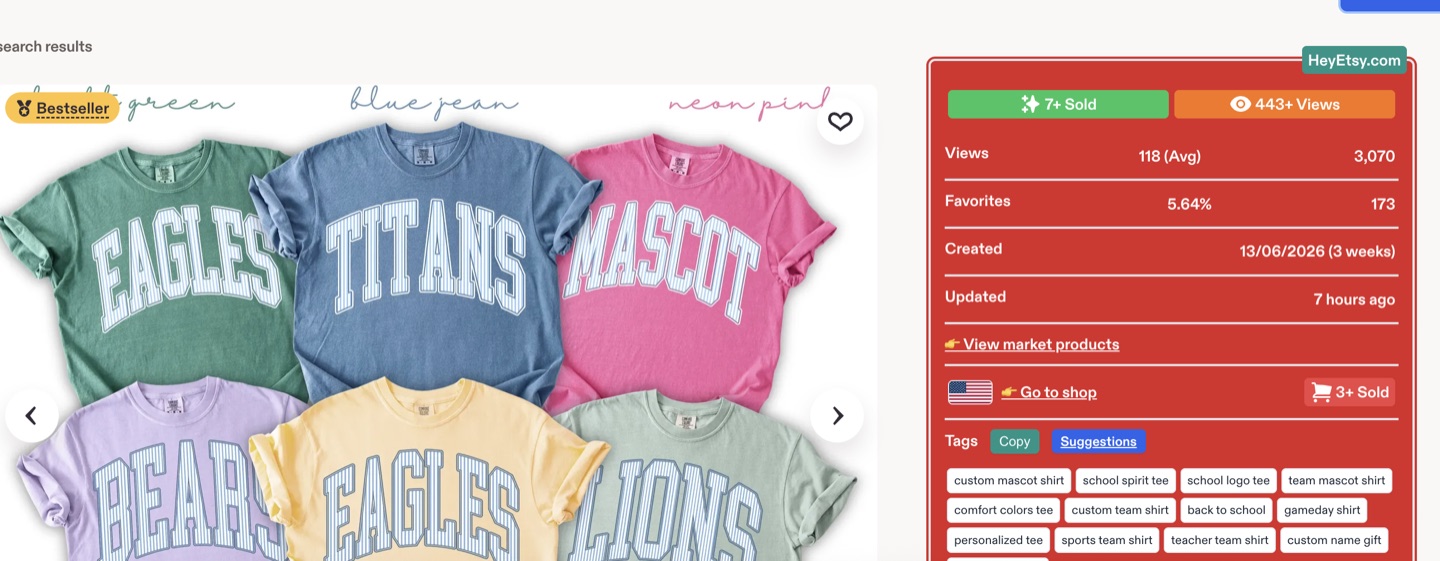
Recently I spotted a listing performing very well: a 2D printed t-shirt with a simple centered graphic and a short custom text line. The data on the listing:
- 7+ sold in the last 24 hours
- 443+ recent views, average 118/day
- 3,070 total favorites
- 5.64% favorites-to-views conversion rate
- Listing created 3 weeks ago: fresh, not coasting
- Updated 7 hours ago: active seller
Etsy itself was showing the "In demand · 6 people bought this in the last 24 hours" red strip on the listing. Etsy's own algorithm agreeing with the tool's estimate.
What's the transferable pattern here? I looked at the top 8 other listings in the same broad category (custom text apparel for gifting), and the common thread across the winners was:
- Minimalist composition: one centered subject on solid background. No clutter, no borders, no decorative flourishes competing for attention.
- Short, personal text. 3–5 words maximum. Not sentences. "For the best dad", not "The best father in the whole world".
- Gift-shopper occasion cue. Father's Day, first birthday, memorial. The listing signals why someone is buying.
- High-contrast color: one bold accent color on an off-white background.
None of these four elements is specific to 2D printing. They're a design language that transfers to any wearable product where the buyer wants a personalized gift.
The adaptation. Embroidery is my production capability, not 2D print. So I kept all four transferable elements. Composition, short text, occasion, contrast. And only swapped the medium:
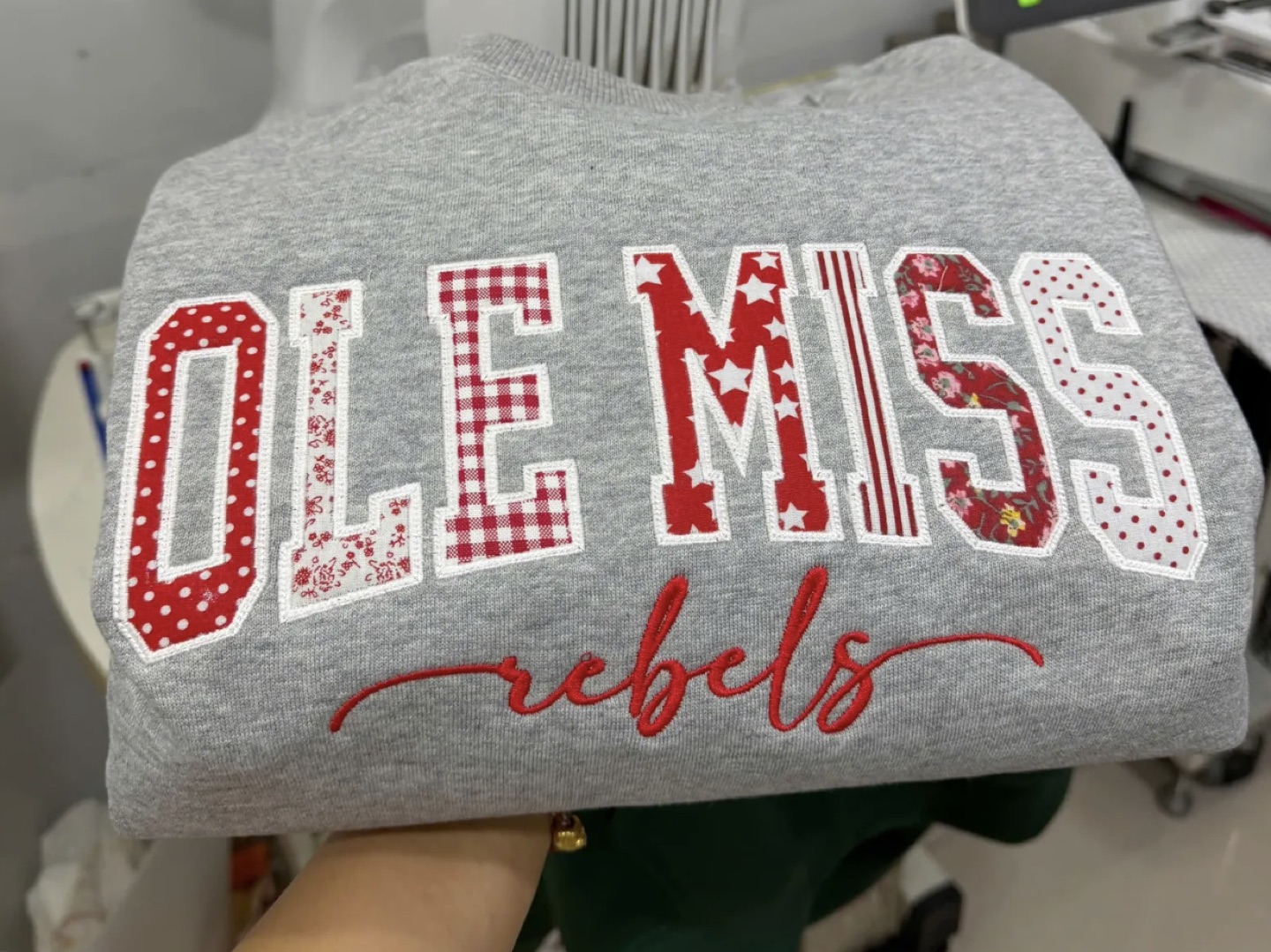
Same visual DNA, different production method. The 2D print market for this pattern is already saturated (dozens of sellers competing on the same keyword). The embroidered version has far less direct competition for the same buyer intent. A gift-shopper searching for "personalized dad shirt" who prefers a premium feel.
That's the whole play. A month of quiet observation replaces a year of guess-and-check.
Categories that transfer well vs categories that don't
Not every pattern transfers. Rough rules from what I've seen work:
Transfers well:
- Composition + occasion (a Mother's Day layout that works on a mug works on a print)
- Personalization variable (adding "custom name" always adds value)
- Aesthetic palette (a coquette color story sells across mugs, prints, jewelry)
Doesn't transfer:
- Specific medium tricks (a hand-lettering effect on paper doesn't work on stainless steel)
- Trend-of-the-week jokes (a Taylor Swift lyric on a mug in album-release week isn't repeatable)
- Anything relying on a specific artist's signature style (that's what makes them irreplaceable)
If the "why is this winning" boils down to "the seller has a distinctive personal style", the pattern isn't yours to take.
Common mistakes
- Copying the whole listing verbatim. If you clone the title, image, and description, you're competing head-to-head with a proven winner on their turf. You will lose. Adapt the pattern, not the product.
- Skipping the "why is this winning" question. If you don't identify which element is doing the work, you'll swap the wrong parts and end up with a listing that has none of the original's magic.
- Adapting to a niche you can't produce for. The pattern only helps if you can actually make the adapted product cheaply and quickly. Don't pick embroidery adaptations if all you can produce is 2D print.
- Building on a single data point. A single winning listing might be a fluke. A paid-ads campaign, a TikTok mention, a personal customer. Confirm the same pattern appears in 3+ winners before you commit.
- Chasing patterns older than 8 weeks. By the time a pattern is 2 months old and has 20 imitators, the buyer's eye is trained on the leaders and the market share is locked in. Fresh patterns give you a head start.
Why this beats "creative" brainstorming
Every seller has ideas. The seller who wins is the one who runs this workflow every 2 weeks like clockwork:
- Scan 3–5 adjacent categories
- Note the top 5 new-winner listings in each
- Extract the transferable pattern from each cluster
- Adapt one pattern to their niche per week
Do this for 3 months and you'll have 12 data-informed products in your shop, each one built on evidence that the pattern converts. Compare that to 3 months of "I hope this design works". No contest.
The seller who spots winners first has 2–4 weeks before the pattern saturates. Data-driven adaptation is that head-start, converted into shop growth.
If manually scanning 5 categories twice a month sounds tedious, that's exactly what HeySeller is built to automate. We surface rising winners across categories, tell you why they're winning, and show which patterns transfer to your niche. Join the beta →